
The Pottery Safety Manual
Boring? Slightly.
Important? Very.
This is a must-read for everyone who loves pottery as much as we do.
Pottery is one of the safer creative hobbies out there, but there are a few health risks worth knowing about.
The good news: they’re entirely manageable with a few simple habits you’ll pick up quickly and then never think about again.
This is us making sure you can keep having fun with clay for the next 40+ years. Here’s what you actually need to know.
| Situation | What to do |
|---|---|
| General handbuilding | Work wet and you're already fine |
| Cleaning up | Damp cloth + damp mop, never dry sweep |
| Airborne particles | HEPA H13 air purifier, running while you work |
| Bone-dry clay, sanding | Outside or FFP3/N99 respirator |
| Mixing raw glazes | FFP3/N99 respirator + nitrile gloves |
| Firing | Ventilation + dedicated circuit + kiln gloves |
01
Setting Up Your Workspace
You don’t need a dedicated studio.
A kitchen table, a spare corner, a fold-out desk: all perfectly fine. The key is how you set it up and how you leave it afterwards.
One thing worth keeping in mind: try to avoid setting up near carpet, heavy curtains, or upholstered furniture.
Clay dust tends to settle into fibers and is tricky to get out completely. Hard floors and wipe-clean surfaces just make your life a lot easier.
USE A WOODEN WORK BOARD.
A wooden board just for clay (a simple piece of untreated plywood or a purpose-made pottery board) gives you a portable, clay-friendly surface to work on. It’s easy to move, easy to clean, and it protects whatever is underneath. When you’re done, wipe it down with plenty of warm water and a sponge, then lean it upright against a wall to dry, either in a covered spot outdoors or in a room your kids and pets can’t get into.
COVER YOUR TABLE WITH PLASTIC SHEETING.
Lay a sheet of plastic or a big silicone mat underneath your work board. This catches splashes, slip, and stray bits of clay. After your session, carefully fold it inward so nothing spills off, and put it away. Don’t shake it out.
KEEP WATER AND A DAMP SPONGE NEARBY.
You’ll use them constantly anyway, and they’re your best tools for keeping everything clean as you go.
02
The Thing Worth Taking Seriously:
Dust
This is the main health risk in home pottery, and it’s easy to manage once you understand it.
Clay contains crystalline silica. When silica dust gets into the air and is breathed in repeatedly over a long period of time, it can cause silicosis, a form of lung scarring.¹
That sounds alarming, so here’s the honest context: silicosis is known as an occupational disease. It typically develops in people who breathe in silica dust at work, day after day, usually for ten years or more.²
A few hours a week of handbuilding at your kitchen table is a very different situation. Not zero risk, but one the habits below take care of.
The key word in all of this is dust. Wet clay produces none. The risk comes from dry clay being disturbed: swept, sanded, scraped, blown.³
The habits that keep you safe:
Work with clay while it’s wet or leather-hard.
Most handbuilding happens at this stage anyway.
Clean up while everything is still damp.
Wipe surfaces with a wet cloth and mop the floor with a damp mop. Never sweep dry clay dust with a brush or broom. That throws the particles right back into the air.³ ⁴
Get an air purifier with a HEPA H13 filter.
This is the one piece of equipment worth buying, and it also just makes your space nicer to work in. H13 is a filter class under the European standard EN 1822: it has to trap at least 99.95% of the fine particles that pass through it.⁵ Run it while you work and for a while afterwards, so it has time to clean the air in the room. Change the filter as the manufacturer recommends, because a clogged filter stops working properly.
Sand and scrape outside.
If you do need to sand or scrape a bone-dry piece, do it outside if possible, or wear an FFP3/N99 respirator.³ Not a cloth mask: that won’t catch fine silica particles. This doesn’t come up often for most hobbyists, but it’s the one moment where extra care is worth it.
Wash your hands.
Wash your hands before eating or drinking. (Yeah, we know, you were gonna anyway. Just covering our bases.)
Sources
¹ NIOSH (CDC): The Continuing Persistence of Silicosis. https://www.cdc.gov/niosh/blogs/2011/silicosis.html
² NIOSH (CDC): NIOSH Alert, Request for Assistance in Preventing Silicosis and Deaths in Rock Drillers, Publication No. 92-107. https://www.cdc.gov/niosh/docs/92-107
³ Australian Government, Asbestos and Silica Safety and Eradication Agency: Pottery and ceramics. https://www.asbestossafety.gov.au/silicasafety/about-silica/practical-guidance/pottery-and-ceramics
⁴ UK Health and Safety Executive (HSE): Ceramics: Silica, CR1. https://www.hse.gov.uk/PUBNS/guidance/cr1.pdf
⁵ MANN+HUMMEL: DIN EN 1822, the European test method for high efficiency air filters. https://airfiltration.mann-hummel.com/en-uk/insights/filter-classification/din-en-1822.html
03
Glazes

Good news: if you’re using ready-mixed commercial glazes, you’re already in low-risk territory. They come wet, so there’s no dust to breathe in. Apply them as directed, wash your hands after, and please don’t eat them. Wipe up drips and spills while they’re still wet, because dried glaze turns to dust.⁶
One thing that really matters for mugs, bowls and plates: only use glazes labeled food safe or dinnerware safe on anything that touches food or drink. Some glazes are only food safe under a clear glaze, and the label only holds if you fire to the temperature the manufacturer recommends.⁷ ⁸ It’s all on the jar.
If you ever mix your own glazes from raw materials, wear nitrile gloves and an FFP3/N99 respirator. Glaze powders contain high levels of silica, and every raw material comes with a safety data sheet worth reading before you open the bag.
Add the powder to the water, not the other way around, to keep the dust down.³ Once it’s mixed, the dust risk is gone, as long as spills don’t dry out.⁶
Sources
⁶ UK Health and Safety Executive (HSE): Ceramics: Silica, CR5 (spraying glazes and colours). https://www.hse.gov.uk/PUBNS/guidance/cr5.pdf
⁷ Mayco Colors: Food safe and dinnerware safe definitions. https://www.maycocolors.com/?p=5864
⁸ Bath Potters: Ahi Spectrum Shino Glaze, manufacturer’s note on dinnerware safety. https://www.bathpotters.co.uk/ahi-spectrum-shino-glaze/p2724
04
Your Kiln
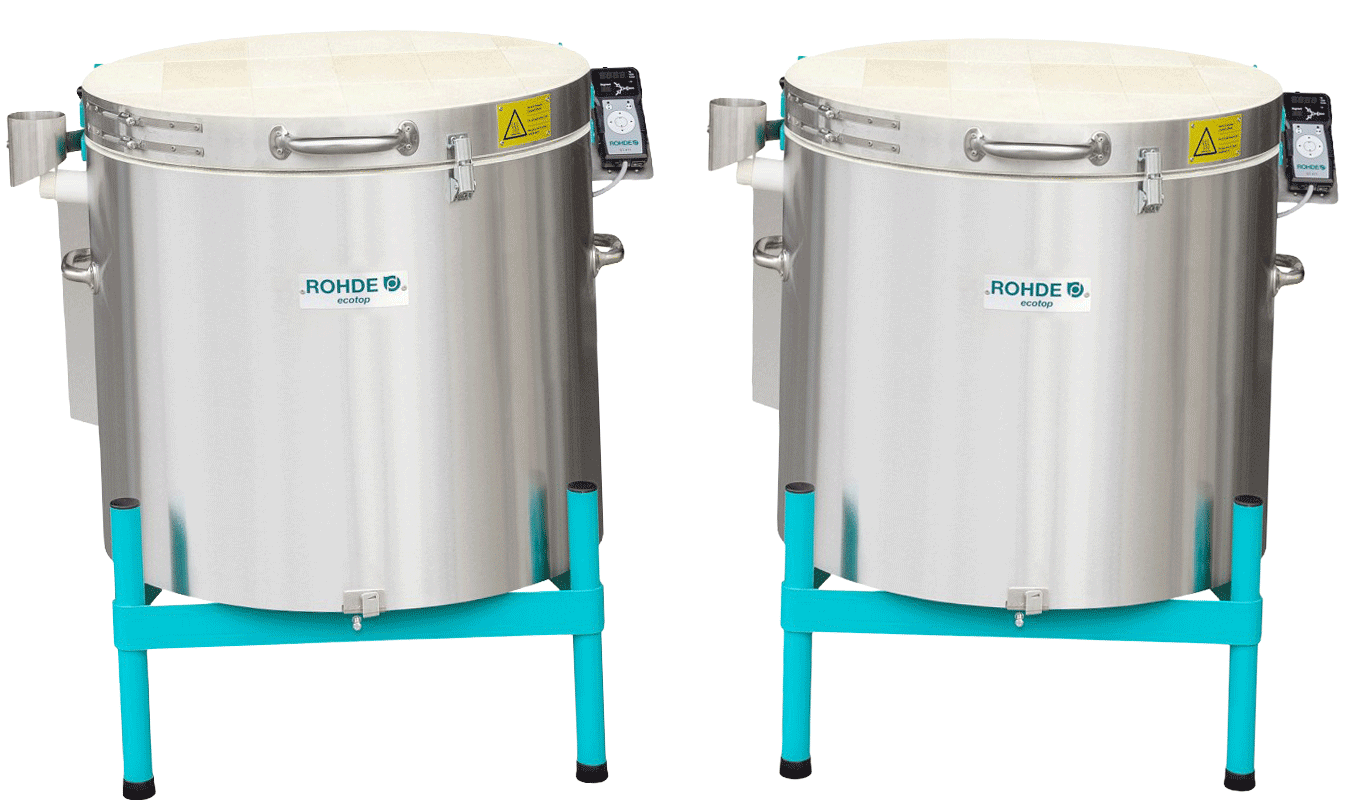

If you fire at home, two things are non-negotiable: a dedicated electrical circuit installed by a licensed electrician (no extension cords, ever. We mean it.)¹⁰ ¹¹ and good ventilation. During firing, kilns release fumes such as carbon monoxide and sulfur compounds that you really don’t want to breathe in.⁹ ¹⁰
A shed, a well-ventilated outbuilding, a purpose-built kiln space, or a room with a kiln vent that takes the fumes outside: that’s the right setup.¹⁰ No space for a kiln at home? No problem. Lots of potters use a community studio or a local pottery class just for firing. Completely valid, very common.
Don’t hang around in the same room as a firing kiln if you can avoid it. Let it cool completely before opening, and air out the space before going back in.
Always use kiln gloves when loading and unloading. Yes, even when it should be cool enough. Ask anyone who’s learned that lesson the hard way.
Sources
⁹ Ceramics Monthly (Ceramic Arts Network): Kiln Venting. https://ceramicartsnetwork.org/ceramics-monthly/ceramics-monthly-article/Kiln-Venting
¹⁰ The Ceramic Shop: Kiln safety and installation cautions (iFire). https://www.theceramicshop.com/ifirecontent/ifireinfo.pdf
¹¹ Seattle Pottery Supply: Electric Kiln Installation, information sheet for the installing electrician. https://seattlepotterysupply.com/pages/electrician-kiln-install
THE HONEST BOTTOM LINE
The data on pottery and health is actually reassuring. Even for pottery factory workers breathing silica dust on the job for 45 years, a large study estimated the lifetime silicosis risk at 0.6%, as long as the dust stayed within today’s recommended limit.¹² ¹³ A well-run home studio with wet working habits and a good air filter is a completely different league.
Work wet. Clean damp. Run your HEPA H13. Those three habits cover almost everything, and once they’re second nature you’ll never think about them again.
Pottery is good for you. Now go make something beautiful.
Sources
¹² Wang D, et al. Comparison of Risk of Silicosis in Metal Mines and Pottery Factories: A 44-Year Cohort Study. Chest, 2020. https://pubmed.ncbi.nlm.nih.gov/32298729
¹³ NIOSH (CDC): Health Effects of Occupational Exposure to Respirable Crystalline Silica, 2002. https://stacks.cdc.gov/view/cdc/6887